.png)
.png)
Your Screen Is Ageing Your Skin: The Blue Light Pigmentation Truth No One Is Talking About

It is 2:47 PM. You are three hours into your workday. Your screen is bright. Your eyes are tired. And somewhere under your skin, a process is already happening that you cannot see.
Melanin is being triggered.
You are sitting at your desk, indoors, SPF on from this morning. You think you are safe from pigmentation. You think screens do not matter.
You are wrong. But not in the way TikTok told you.
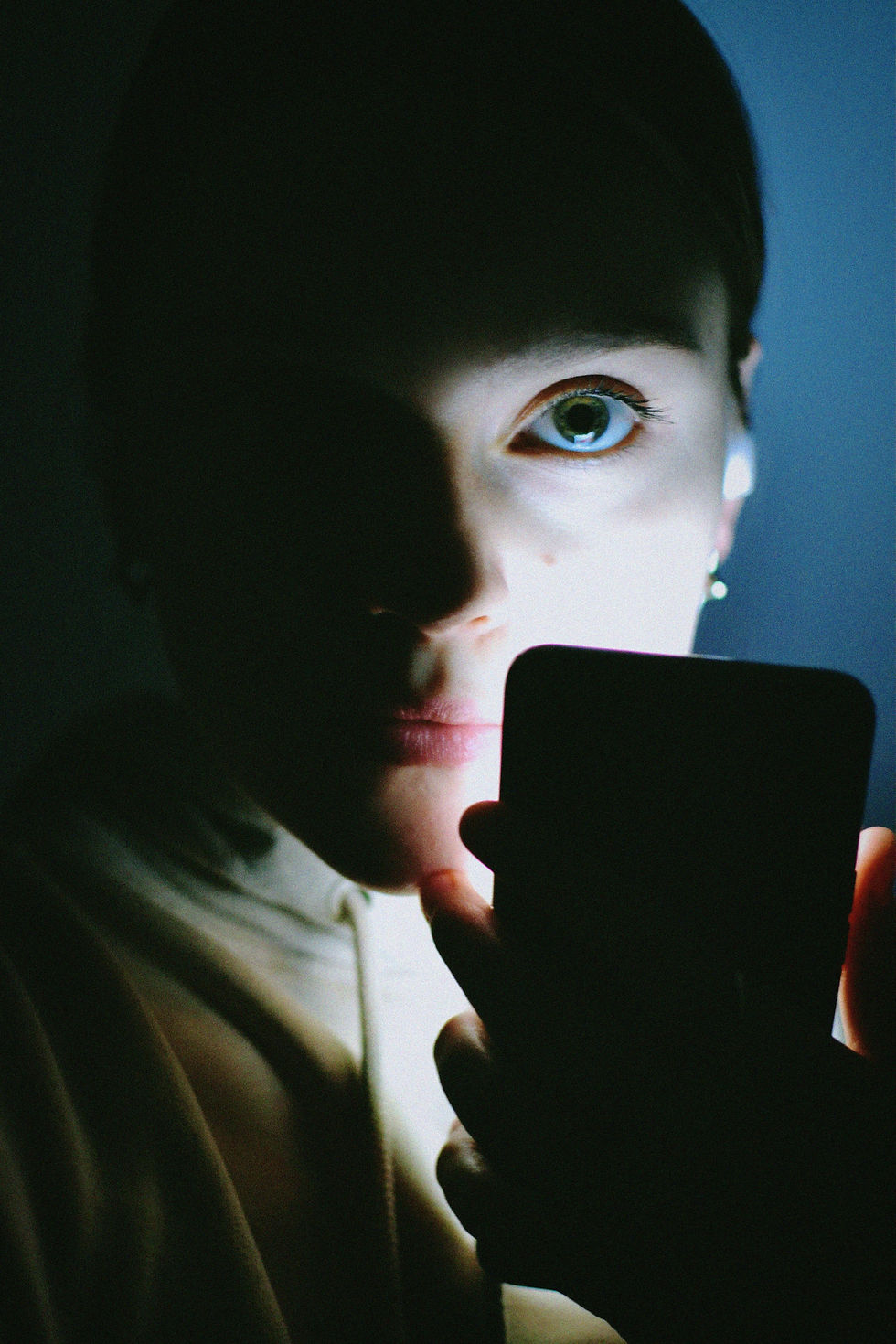
Your Screen Is Not Causing Sun Damage — But It IS Causing Something
Let us start with what screens do not do.
Your computer monitor does not emit UV radiation. Your phone screen does not produce UVA or UVB. The SPF50+ you wore this morning is not being used up by your laptop.
That is important — because if you have been worried about sun damage from your screen, you can stop.
But here is where it gets more interesting. Your screen emits blue light and infrared radiation. And both of these CAN trigger the same melanin production pathway that UV does — just through a different mechanism. And that mechanism is damaging your skin every day, whether you know about it or not.
How Blue Light Actually Triggers Pigmentation
In 2019, research published in Photochemistry and Photobiology examined how high-energy visible light — the blue light range — penetrates human skin. The finding was significant: blue light penetrates deeper than UV does.
UVB stops in the epidermis. UVA reaches the dermis. But blue light reaches the deepest layers of your dermis, right where your melanocytes live. Once there, it creates reactive oxygen species — free radicals that trigger oxidative stress, activate tyrosinase, and tell your skin to produce more melanin.
Human studies show HEV light can increase melanin production by up to 40% in skin prone to melasma or hyperpigmentation — with zero UV involved (Journal of Cosmetic Dermatology, 2021).
Your screen is not the sun. But it is triggering the same response inside your skin.
The Hidden Problem: What Blue Light Does to Your Skin Barrier
Blue light does not just trigger melanin. It also damages the skin barrier itself.
Research shows that chronic HEV exposure disrupts barrier integrity by reducing ceramide levels, increasing transepidermal water loss, and elevating inflammatory markers including IL-6 and TNF-alpha. Your skin becomes inflamed at a low, chronic level — and you do not feel it.
A compromised barrier means more pigmentation. Because a weak barrier cannot protect melanocytes from oxidative stress signals. More stress signals equal more melanin. More melanin equals darker spots and uneven tone.
This is why desk workers often have the worst pigmentation. Not from the screen alone — but from blue light plus a weakened barrier plus stress hormones plus forgotten SPF. It is a compounding effect that builds silently over months.
The Infrared Problem Nobody Mentions
While blue light gets all the attention, screens also emit infrared radiation — and IR has its own skin damage pathway.
Research in Photomedicine and Laser Surgery confirms that chronic infrared exposure increases collagen breakdown via MMP upregulation, triggers heat-shock protein responses that paradoxically increase melanin production, and accelerates oxidative stress in skin cells.
Your screen heats your skin locally. Your body interprets that heat as a threat. Protective melanin gets produced in response. This is why your skin can look more stressed and more pigmented after a long day at a screen — even in winter, even indoors, even nowhere near a window.
Do You Actually Need SPF If You Work Indoors?
Yes. But not for the reason you think.
Sunscreen does not block blue light. SPF protects against UV radiation — a completely different wavelength. No SPF, no matter the number, is going to meaningfully block what your screen is emitting.
So why do you still need it?
Because most screen workers are also exposed to incidental UVA through windows. UVA penetrates glass. UVB does not. Eight hours sitting near a window means eight hours of steady UVA exposure — compounding everything the blue light is already doing.
And the combination of UVA through glass plus blue light from your screen plus cortisol from screen-based stress is what turns a manageable pigmentation issue into dark spots that will not budge.
The rule: Beauty of Joseon Relief Sun SPF50+ PA++++ every morning. Reapply every two hours if you are window-adjacent. If you are deep indoors with zero windows, one morning application is fine — but use those hours to layer antioxidants and targeted melanin inhibitors instead.
Who Is Actually At Risk
Screen-triggered pigmentation is not universal. But if any of these apply to you, screen time is a real, clinically relevant pigmentation accelerator:
You have a history of melasma — blue light and heat are known melasma triggers and can darken existing patches significantly.
You have deeper skin tones — Brown, Black, Asian, and Hispanic skin has a higher melanin baseline, meaning more melanin is available to be triggered by oxidative stress signals.
You deal with post-inflammatory hyperpigmentation from acne or eczema — PIH-prone skin is hypersensitive to any additional melanin trigger.
You work under stress with high screen time — cortisol and oxidative stress compound together.
You sit near a window — UVA plus blue light is the real double hit.
If that is you, this is not a skincare myth. It is happening to your skin right now.
The Three-Layer Defence That Actually Works
Layer 1: Antioxidant protection in the morning
Your skin cannot avoid blue light oxidative stress — but you can neutralise it before it triggers melanin. Niacinamide applied topically has been shown to reduce HEV-induced reactive oxygen species by up to 67% and decrease melanin production by 45% compared to untreated skin (Molecules, 2020). Propolis, rice extract, and fermented actives all contribute additional antioxidant protection.
Layer 2: Barrier repair morning and night
A strong barrier is your skin's first line of defence. Ceramides, centella asiatica, and panthenol are all clinically proven to restore barrier function and reduce the inflammatory signals that drive melanin production. In clinical trials, participants with repaired barriers showed significantly reduced blue-light-induced pigmentation compared to those with compromised barriers.
Layer 3: Targeted melanin inhibition at night
Vitamin C blocks tyrosinase — the enzyme that creates melanin. Tranexamic acid inhibits the melanocyte transfer pathway. Niacinamide reduces melanin synthesis at the cellular level. Used together, they hit pigmentation from three separate biological angles. This is why combination actives outperform single-ingredient serums for screen-worker pigmentation.
The K2C Answer: Pigment Corrective Kit
If you are a screen worker with stubborn dark spots, melasma, or uneven tone that seems to worsen no matter what you try — your skin is in a pigmentation state. And that state is being fed by your screen every single day.
The K2C Pigment Corrective Kit was designed for exactly this profile.
It starts with a double cleanse to remove SPF residue and daily buildup — because nothing that follows works if your skin is not clean. The I'M FROM Rice Toner then primes your skin with ferulic acid, a clinically proven antioxidant that neutralises blue-light-triggered free radicals before they reach your melanocytes.
The MISSHA Time Revolution First Essence 5X follows — 77% bifida ferment lysate that accelerates cell renewal so your damaged, pigmented cells turn over faster. Faster turnover means faster fade.
The Beauty of Joseon Glow Serum delivers propolis and niacinamide — anti-inflammatory, ROS-blocking, tyrosinase-inhibiting, and barrier-strengthening in one step.
Then the Dr. Althea Vitamin C Boosting Serum at 63% concentration does the heavy lifting at night — directly inhibiting melanin synthesis at the enzymatic level.
The Dr. Althea 345 Relief Cream seals every layer with ceramides and peptides so your barrier stays strong enough to tolerate the actives and defend against further screen damage.
Once a week, the MISSHA First Essence Mask delivers a 20-minute acceleration of cell renewal at clinical concentration — compounding the daily work your serum is doing.
And every single morning, the Beauty of Joseon Relief Sun SPF50+ PA++++ protects everything you built the night before from UVA, incidental light, and the cumulative damage that steals your results.
Remove any one of these layers and you create a gap. Together, they address every mechanism: oxidative stress, barrier damage, melanin production, cell renewal slowdown.
What Results Look Like
Week 1 to 2: Barrier strengthens. Skin feels different — more hydrated, less reactive. Tone may even look more even from improved hydration alone.
Week 3 to 4: Dark spots start to lighten. Texture around pigmented areas smooths. Uneven tone becomes visibly more even.
Week 6 to 8: Real transformation. Spots noticeably lighter. Tone genuinely more uniform. Melasma softens.
Week 12 and beyond: The compounding effect. This is when people stop asking if you changed your foundation.
Your Skin State. Right Now.
You are not a pigmentation type. You are a desk worker in a pigmentation state — and that state is temporary. Reversible. Treatable.
You just need a system designed for what is actually causing it.
Take the K2C Skin Quiz — 5 questions, 2 minutes. We will confirm whether the Pigment Corrective Kit is your next step, or whether your skin needs something else first.
Your screen is not going anywhere. But what it does to your skin does not have to stay.
Love always
Mieke💚😉


Comments